Integration Knowledge Modules (IKM)
The IKM is in charge of writing the final, transformed data to the
target table. Every interface uses a single IKM. When the IKM is
started, it assumes that all loading phases for the remote servers have
already carried out their tasks. This means that all remote source data
sets have been loaded by LKMs into "C$" temporary tables in the staging
area, or the source datastores are on the same data server as the
staging area. Therefore, the IKM simply needs to execute the "Staging
and Target" transformations, joins and filters on the "C$" tables, and
tables located on the same data server as the staging area. The
resulting set is usually processed by the IKM and written into the "I$"
temporary table before loading it to the target. These final transformed
records can be written in several ways depending on the IKM selected in
your interface. They may be simply appended to the target, or compared
for incremental updates or for slowly changing dimensions. There are 2
types of IKMs: those that assume that the staging area is on the same
server as the target datastore, and those that can be used when it is
not. These are illustrated below:
When the staging area is on the target server, the IKM usually follows these steps:
-
The IKM executes a single set-oriented SELECT statement to carry out
staging area and target declarative rules on all "C$" tables and local
tables (such as D in the figure). This generates a result set.
-
Simple "append" IKMs directly write this result set into the target
table. More complex IKMs create an "I$" table to store this result set.
-
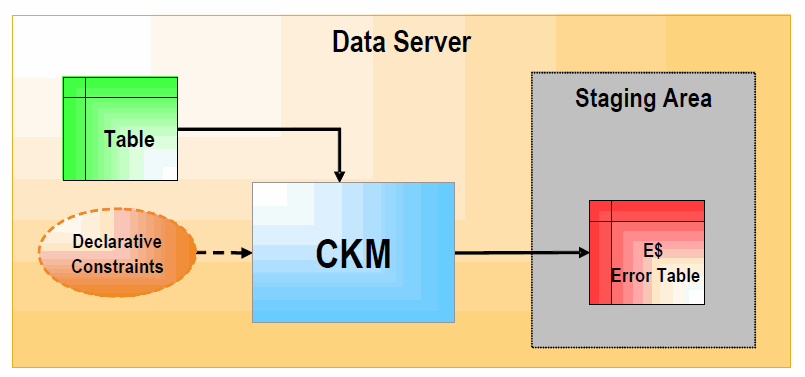
If the data flow needs to be checked against target constraints, the
IKM calls a CKM to isolate erroneous records and cleanse the "I$" table.
-
The IKM writes records from the "I$" table to the target following
the defined strategy (incremental update, slowly changing dimension,
etc.).
-
The IKM drops the "I$" temporary table.
-
Optionally, the IKM can call the CKM again to check the consistency of the target datastore.
These types of KMs do not manipulate data outside of the target
server. Data processing is set-oriented for maximum efficiency when
performing jobs on large volumes.
When the staging area is different from the target server, as shown in
Figure 1-6, the IKM usually follows these steps:
-
The IKM executes a single set-oriented SELECT statement to carry out
declarative rules on all "C$" tables and tables located on the staging
area (such as D in the figure). This generates a result set.
-
The IKM loads this result set into the target datastore, following the defined strategy (append or incremental update).
This architecture has certain limitations, such as:
-
A CKM cannot be used to perform a data integrity audit on the data being processed.
-
Data needs to be extracted from the staging area before being loaded to the target, which may lead to performance issues.